Pricing for the Agent Economy
As AI fragments software procurement into granular, task-driven purchases, billing will move from monthly invoices to real-time settlement.
It was recently reported that Anthropic will curb its subscription model for Claude and begin billing enterprises based on usage. This move is part of a growing shift from SaaS towards usage-based pricing models, driven by artificial intelligence. As these forces continue to make software purchases more granular, discrete, and automated, real-time settlement offers a solution.
Artificial intelligence is putting pressure on SaaS in a few ways:
- Leverage is accruing to the buyer: AI-powered coding assistants are lowering the cost of software development. Even as many firms continue to buy rather than build, buyers now have a credible alternative to subscription renewal and may require lower seat counts, prompting sellers to shift towards flexible, usage-based terms as an alternative.
- Marginal cost is increasing: The compute intensity of inference-based software is causing marginal costs to rise. This makes it difficult for sellers to predict a monthly price point at which the company maintains a comfortable margin, agnostic of usage.
- Switching is getting automated: Parallel usage of LLM’s is common and is spurring development of products that automate task routing across model providers, such as OpenRouter. While an emerging category, these routing tools are an early signal that switching costs for software will dramatically decrease for consumers, making purchases more granular, discrete, and task-oriented.
Usage-based-billing is a viable alternative, but risk and benefits are unevenly distributed.
Typically, usage-based-billing takes one of two forms: pay up front through pre-purchased credits, or pay later when the provider bills you for your monthly usage. These arrangements are solving for a few factors, with risk and value accruing unevenly across the buyer and the seller.
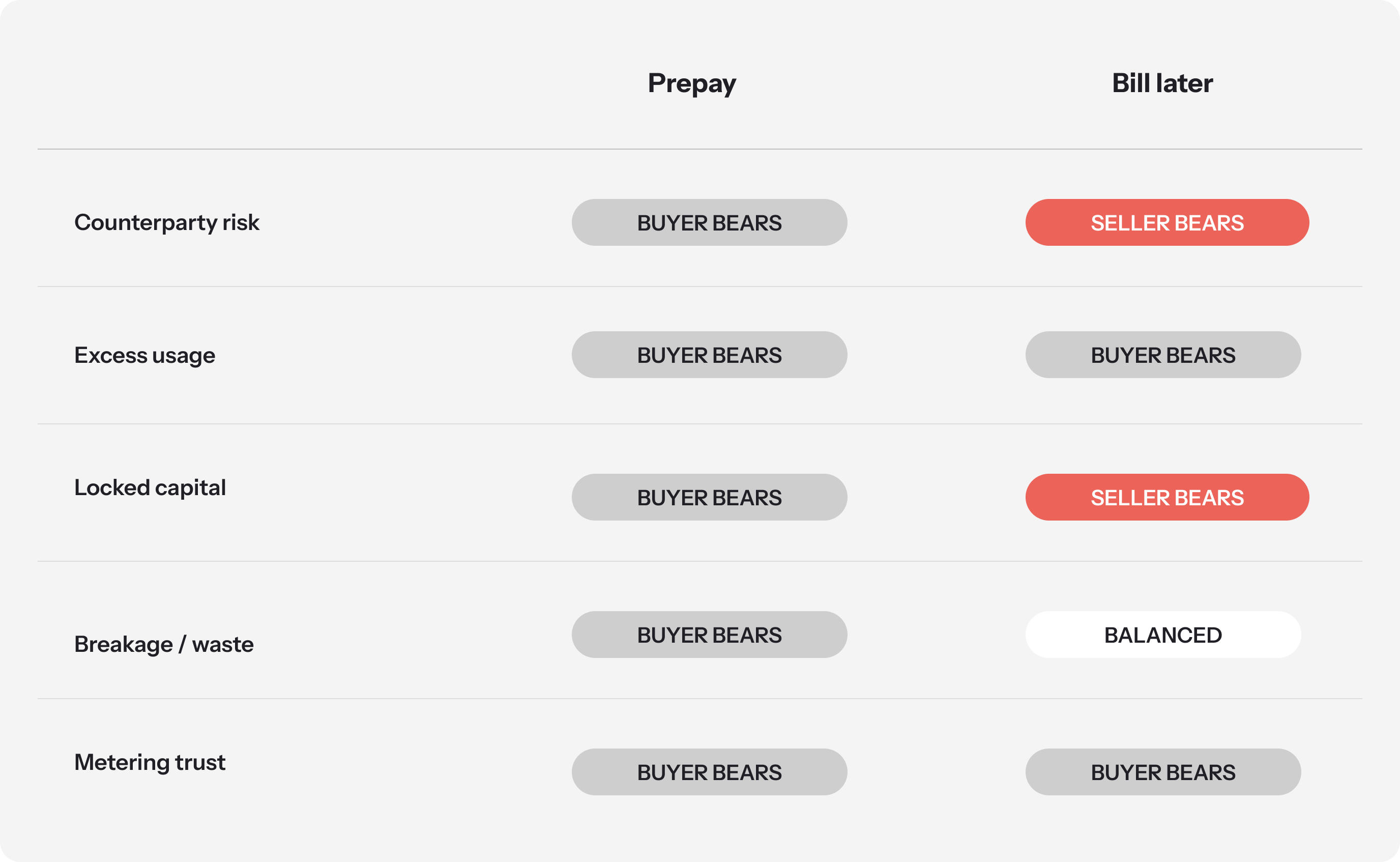
Agent procurement will break usage-based billing in its current form.
Agent-to-agent communication will compress the software procurement cycle and increase purchasing velocity.
Agents are good at doing comparison shopping. They can rapidly evaluate the value of alternative services, weigh it against switching costs, make a decision, and execute. At the same time, agents selling services will attempt to optimize this decision making and onboarding process for the buyer, understanding that any friction reduces the value proposition. This creates an ecosystem where agents are constantly evaluating new tools that can be rapidly provisioned, increasing the velocity of new commercial arrangements.
Software purchases will become more granular, resulting in a fragmented marketplace of buyers and sellers.
Model advancements are making it easier than ever to build and deploy new software services. As barrier to entry decreases, competition rises, and buyers have a more comprehensive range of options for any single task. Sellers who may have previously bundled many services under a single subscription may be forced to unbundle, increasing their ‘SKUs’, and offering more services a la carte. This increasing granularity of purchases means that sellers must manage an increasing number of users across many services, and buyers must manage a fragmented portfolio of vendors.
Real-time settlement offers a practical pricing model for the agent economy.
Real-time usage-based payments support an ecosystem where liquidity moves freely across optimized pairs of buyers/sellers, balances accrue in real-time, and counterparty risk is minimized across the system.

- Reduced credit exposure for sellers: Streamlined onboarding across a fragmented market of buyers means it may not be prudent for a seller to extend credit in the form of monthly billing. Sellers may not be able to trust agent buyers in the same way they trusted their human counterparts. When services are billed as resources are consumed, sellers can offer the same products at a lower trust threshold.
- Minimization of locked capital for buyers: Pre-purchased credits force a user to lock liquidity with a single vendor. This is increasingly unsustainable as the number of vendors rises. If agents pay as they consume, companies can deploy capital in real-time as needed.
Usage-based billing is a necessary evolution of SaaS. As agents become actors in software procurement, they need a different model. Real-time settlement is built for the agent economy.
Interested in exploring pricing built for agents? Get in touch.
Build on Radius
Get in touch with our team to discuss your next project.