Escrow on Radius: Spending Caps for the Agent Economy
Radius’ Escrow Contract lets users authorize maximum spend limits, meter usage in real time, and settle only what was consumed.
Usage-based billing is becoming the default pricing model for agentic software. As workflows become autonomous, users may call APIs, access inference, or stream content for discrete, task-oriented periods.
While usage-based pricing adapts to these demand patterns, it introduces a new problem for buyers: without ongoing monitoring, they may end up spending more than they want.
This exposure is amplified for agentic workflows. While a user may observe a service running longer than expected, they may not have full visibility into the price of the workflow until the task completes.
Introducing Escrow Contracts on Radius
Escrow contracts on Radius solve this problem. By allowing buyers pre-authorize spending limits for specific resources, they cap their exposure to unwanted spend. Both parties have clear traceability of the end-to-end cost of a task.
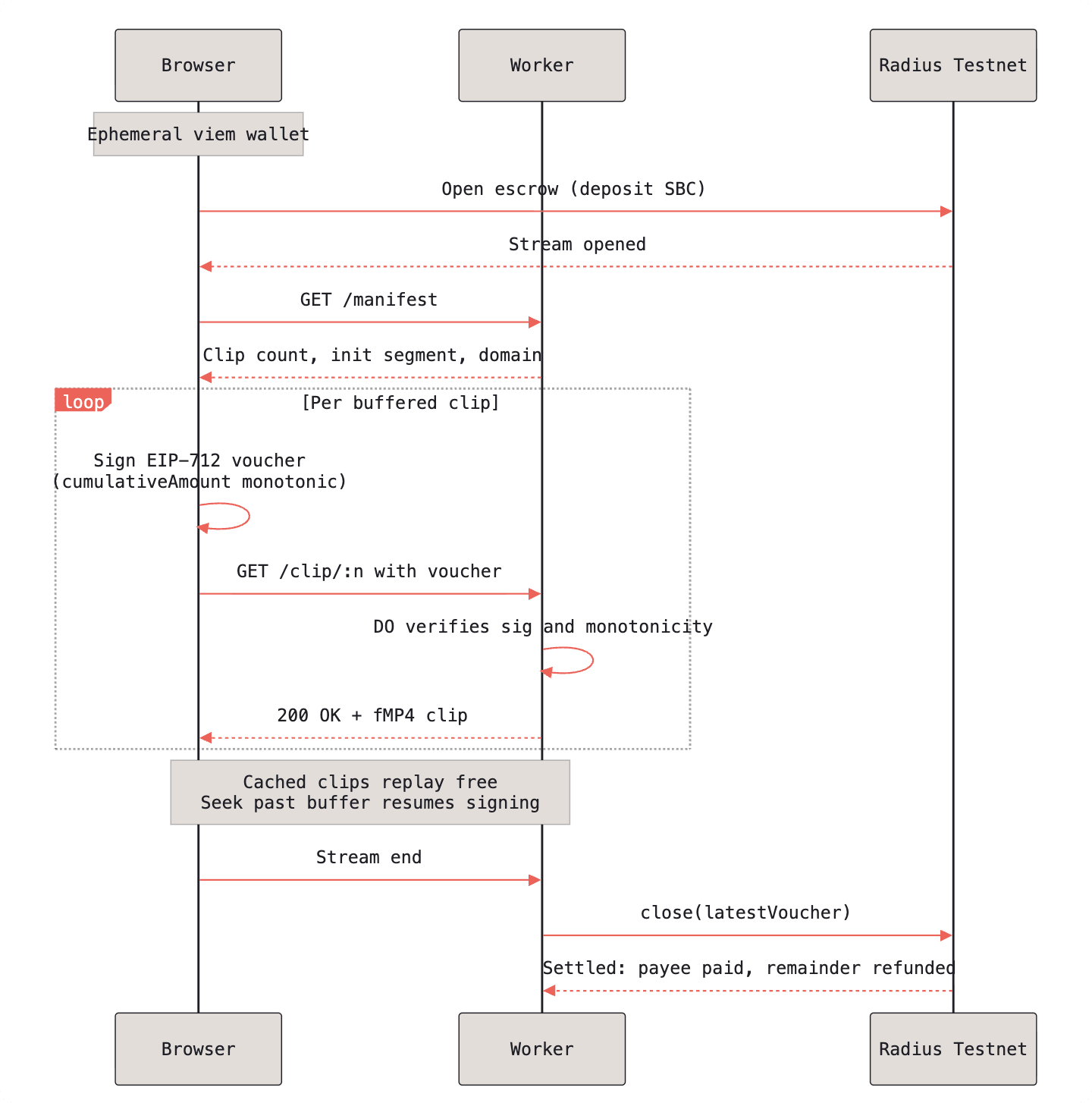
As services are consumed, a real-time balance is computed and stored in an edge stage using Cloudflare’s Durable Objects. When the buyer terminates access to the service or reaches the spending cap, the total value settles to the seller and any unused funds are returned to the buyer.
Goldberg Sessions: Putting escrow payments into practice
We’ve added a new application to our Project Library, Goldberg Sessions, that demonstrates this functionality. Goldberg Sessions is a working demo of escrow payments on Radius, where users authorize a capped payment to stream a public-domain recording of Bach’s Goldberg Variations.
At the start of a streaming session, the user or agent pays into an escrow contract address up to a cap, in this case, the cost of playing the media end-to-end. Each 5-second clip costs 0.001 SBC to stream.
As new clips are buffered, the client signs an off network EIP-712 voucher for the running cumulative total.
When the user terminates the stream or when the piece ends, whichever occurs first, the final payment settles on the Radius Network and any unused funds are returned to the buyer.
Autonomous commerce needs controls, flexibility, and composability.
Emerging business models like pay-as-you-go and streaming payments can be de-risked with real-time settlement.
However, buyers also need confidence that usage will remain bounded, auditable, and easy to reconcile. Patterns like Radius’s Escrow Contract demonstrate the range of spending and consumption controls that can be enabled for emerging business models.
Critically, the Radius Network is fully EVM compatible. As new forms of commerce are created, maintaining the composability of money through open and shared standards like the EVM is crucial to supporting innovation and interoperability.
Interested in learning more? Talk to our team or get started with Escrow Payments on Radius today.
Build on Radius
Get in touch with our team to discuss your next project.